Input seekers,
While we're talking about the Olmecs, why did they carve those gigantic heads? Why did they bring the huge stones from so far away?
It reminds me of Stonehenge, of course, which I visited in the 1970's. Back then we could still walk among the stones and we left our daughter in her stroller in the shade of one of the stones while we took pictures. You can't do that now, I guess.
Where did those early peoples get the huge stones for that monument? clock? calendar? astronomical observatory? Why? How did they know to line them up so perfectly? How did they stand them up and bury so much of the stones in the ground?
There are many stone mysteries in the world -- pyramids, Easter Island faces, Costa Rican stone spheres. Any answers to these enigmas?
DataLight
Wednesday, January 27, 2010

Sunday, January 24, 2010
Inventing Zero
The Olmecs have been credited for coming up with the "concept of zero." Well, what does that mean? Surely everyone in every age understood the concept of having "none" or of "all gone", as in "There are no elefants in the room." or "The cookies are all gone."
What's meant is that mathematically, arithmetically, or in a "counting" sense, the Olmecs found the need to use a glyph as a place holder in a number that had nothing in a certain place value. So they had a picture or glyph that was put there. Just like the number, "405" means 4 hundreds, no tens and 5 ones. You can't leave the tens indicator out; it would change the number to 45.
So were they the "first"? Or just the first in their area? Or is it just remarkable that they had such a concept in their system of numbers?
DataLight
What's meant is that mathematically, arithmetically, or in a "counting" sense, the Olmecs found the need to use a glyph as a place holder in a number that had nothing in a certain place value. So they had a picture or glyph that was put there. Just like the number, "405" means 4 hundreds, no tens and 5 ones. You can't leave the tens indicator out; it would change the number to 45.
So were they the "first"? Or just the first in their area? Or is it just remarkable that they had such a concept in their system of numbers?
DataLight
Thursday, January 14, 2010
Books -- lots to read
Input seekers,
There are lots of books to read about the calendar and I am especially intrigued by those that tell how the research has led to the conclusions we've made about the Mayans and their knowledge.
But when will I have time to read them? So much to do, so little time to do it.
My public library has a few that I will look into before I buy any. Here are two I'd like to start with:
Breaking the Maya Code, by Michael D. Coe
The Code of Kings: the language of seven sacred temples and tombs, by Linda Schele and Peter Matthews
DataLight
There are lots of books to read about the calendar and I am especially intrigued by those that tell how the research has led to the conclusions we've made about the Mayans and their knowledge.
But when will I have time to read them? So much to do, so little time to do it.
My public library has a few that I will look into before I buy any. Here are two I'd like to start with:
Breaking the Maya Code, by Michael D. Coe
The Code of Kings: the language of seven sacred temples and tombs, by Linda Schele and Peter Matthews
DataLight
Tuesday, January 12, 2010
Just the facts, please
Bloggers,
I've discovered a few blogs that deal with the Aztec or Mayan calendar that are mostly about the superstitious and prophetic side of it.
I'm more interested in the facts. What did these ancient people understand about astronomy and time, how did they know it, and how did they record it? I would like to know more about the research done on the codices to come to the conclusions or suppostitions that we have about the calendar.
DataLight
I've discovered a few blogs that deal with the Aztec or Mayan calendar that are mostly about the superstitious and prophetic side of it.
I'm more interested in the facts. What did these ancient people understand about astronomy and time, how did they know it, and how did they record it? I would like to know more about the research done on the codices to come to the conclusions or suppostitions that we have about the calendar.
DataLight
Tuesday, January 5, 2010
Johnny 5
Fellow pursuers of input,
How many of you recognize my profile portrait?
It's "Johnny 5", the robot from the movies Short Circuit and Short Circuit II.
Remember when he gets to New York and discovers that he's in a city? He takes off down the street demanding "Input. More input!"
I especially liked the way he consumed the books in the bookstore, stopping in the middle of the mystery, as he flipped the pages faster than you can blink, that "the butler did it." Cute! [But tell me, why, after reading the encyclopedia, coudn't he speak better English? Come on!]
The Mayans had massive amounts of knowledge about math, time, astronomy, the earth, architecture. It boggles my mind.
Just think about it. To get to the endpoint of designing and building "El Castillo", the pyramid at Chichen Itzá, in Yucatán, México, with its precise alignment to the sun to show the equinoxes, not to mention its other astronomical and calendar features, these primitive people had to accumulate and pass down to their children knowledge of the moon, sun, earth, day and night, and the stars. How did they do this without paper? without computers? without calculators, star charts, graph paper, pencils, erasers? clocks?
I don't get it. Or, as the robot on the original TV show, "Lost in Space", would say, "It does not compute."
Boggled,
DataLight
How many of you recognize my profile portrait?
It's "Johnny 5", the robot from the movies Short Circuit and Short Circuit II.
Remember when he gets to New York and discovers that he's in a city? He takes off down the street demanding "Input. More input!"
I especially liked the way he consumed the books in the bookstore, stopping in the middle of the mystery, as he flipped the pages faster than you can blink, that "the butler did it." Cute! [But tell me, why, after reading the encyclopedia, coudn't he speak better English? Come on!]
The Mayans had massive amounts of knowledge about math, time, astronomy, the earth, architecture. It boggles my mind.
Just think about it. To get to the endpoint of designing and building "El Castillo", the pyramid at Chichen Itzá, in Yucatán, México, with its precise alignment to the sun to show the equinoxes, not to mention its other astronomical and calendar features, these primitive people had to accumulate and pass down to their children knowledge of the moon, sun, earth, day and night, and the stars. How did they do this without paper? without computers? without calculators, star charts, graph paper, pencils, erasers? clocks?
I don't get it. Or, as the robot on the original TV show, "Lost in Space", would say, "It does not compute."
Boggled,
DataLight
Sunday, January 3, 2010
Ollin or ollins?
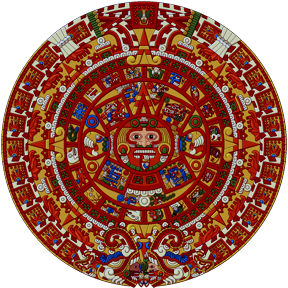
There is so much information online about the Aztec Calendar. I've started a list for links to the right and the first link I put up is a fascinating animation of the Central Circle of Ollins of the calendar.
That brings up a question I have. (I have lots of questions.)
Ollin means "movement" and refers to the Central Ring and its 4 glyphs or symbols relating to the end of the first 4 eras. So are the symbols called "ollins"? or are they all just "ollin" (like "movement" in English which doesn't have a plural)? Or is it the whole of the Central Ring?
Ollin is also one of the 20 daysigns, the glyph movement or earthquake.
That brings up a question I have. (I have lots of questions.)
Ollin means "movement" and refers to the Central Ring and its 4 glyphs or symbols relating to the end of the first 4 eras. So are the symbols called "ollins"? or are they all just "ollin" (like "movement" in English which doesn't have a plural)? Or is it the whole of the Central Ring?
Ollin is also one of the 20 daysigns, the glyph movement or earthquake.
Saturday, January 2, 2010
Hello new year, hello blogging world
Ok, I'm starting a blog. Finally.
My intent for this blog is to learn and log. I want to learn what blogging is all about and how I can use it in my classroom. I also want to log what I'm learning about the many subjects I'm interested in.
I teach high school Spanish and am currently preparing lesson plans to teach the Aztec or Mayan Calendar. I am fascinated by the early civilizations that understood astronomy and mathematics. So, for now, this blog will be focusing on the Mayan calendar -- all of the theories, discoveries, mathematical possibilities, symbolism and myths that surround it.
Datalight
My intent for this blog is to learn and log. I want to learn what blogging is all about and how I can use it in my classroom. I also want to log what I'm learning about the many subjects I'm interested in.
I teach high school Spanish and am currently preparing lesson plans to teach the Aztec or Mayan Calendar. I am fascinated by the early civilizations that understood astronomy and mathematics. So, for now, this blog will be focusing on the Mayan calendar -- all of the theories, discoveries, mathematical possibilities, symbolism and myths that surround it.
Datalight
Subscribe to:
Posts (Atom)